Slack vs Recentriq: Communication Is One-Tenth of Running a Business
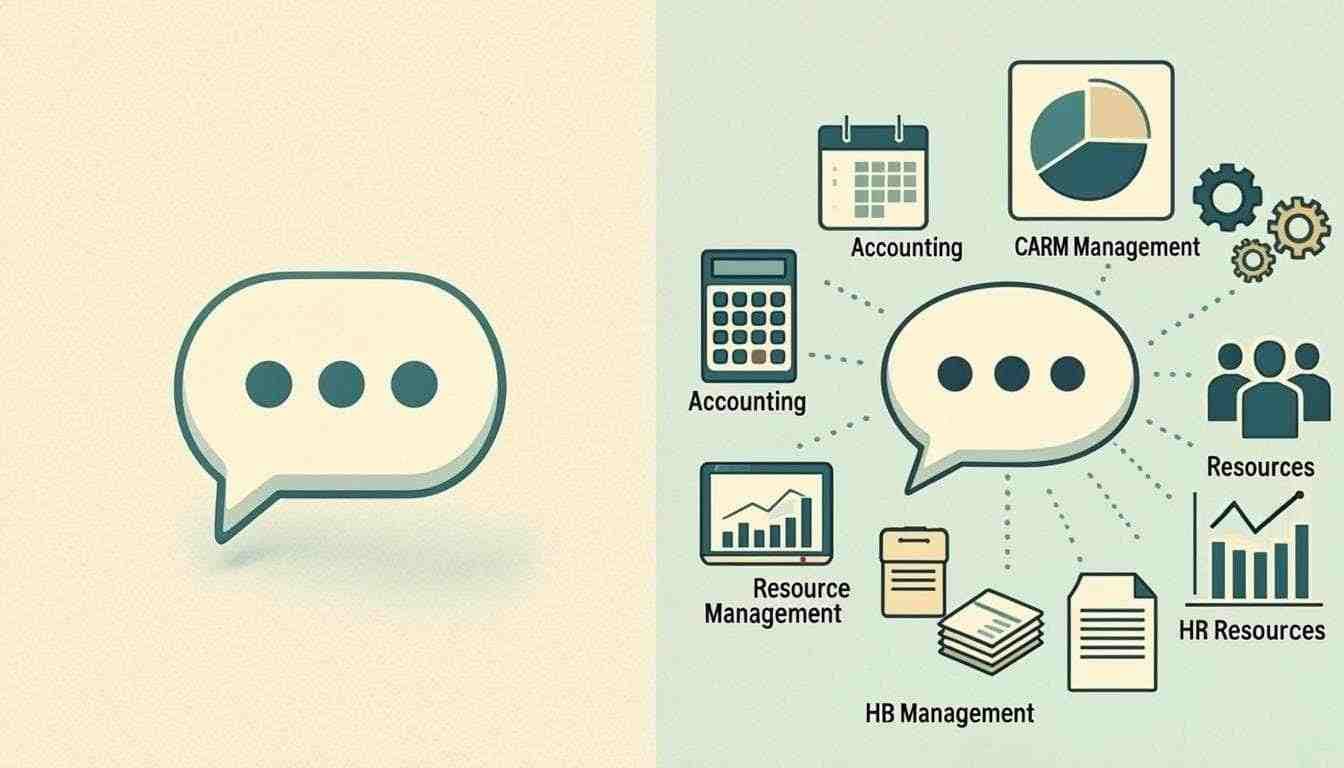
- Slack is a strong tool in its category, but it doesn’t cover the full spectrum of business operations—CRM, finance, projects, HR, and communication.
- A 10-person team using Slack as their core typically spends $300–$800/month on a multi-vendor software stack to cover all business functions.
- Recentriq provides CRM, finance, projects, HR, and team chat in one platform at $5/user/month—eliminating both the cost and complexity of multi-vendor software stacks.
- The right choice depends on whether your priority is best-in-class depth in one function or unified breadth across all business operations.
Slack is the tool that taught an entire generation of office workers what real-time team communication could feel like—channels instead of email threads, threaded replies instead of reply-all chains, integrations instead of copy-paste. For pure messaging, it’s still arguably the best in class. But Slack isn’t a business platform; it’s a communication tool. And the gap between those two things is where growing teams quietly accumulate a $400+/month multi-vendor stack without ever meaning to. You start with Slack for chat. Then you add HubSpot for CRM. Then ClickUp for projects. Then QuickBooks for accounting. Each individual decision is reasonable; together they create a fragmented operation where data lives in four places and nothing quite connects. This guide walks through where Slack genuinely excels, where its single-purpose nature becomes a limitation, and how Recentriq’s $5/user/month unified platform compares once you account for the full stack cost.
Why Compare Slack and Recentriq?
Slack is a well-established tool in the business software space with a loyal user base that, fairly, doesn’t want to give it up. The channel-based messaging model is genuinely better than email for internal communication, and the integrations marketplace means Slack can become a kind of nervous system that touches the other tools in your stack. But as businesses grow, they often find that a single specialized tool isn’t enough—they need CRM, finance, projects, and HR working together, not just notifications about them flowing through a chat channel.
This comparison examines whether Slack alone is sufficient for a growing business, or whether an integrated platform like Recentriq provides better overall value. The honest answer is that it depends on what you’re optimizing for. If you want the best chat tool on the market and are willing to assemble (and pay for) the rest of your stack separately, Slack is a legitimate choice. If you want one platform where chat is connected natively to the CRM contacts, project tasks, and invoices you’re actually discussing, Recentriq is the better fit—and dramatically cheaper once you do the full-stack math.
Slack is the best chat tool on the market. The question isn’t whether it’s good at chat—it’s whether chat is all your business needs to run on.
Slack’s Strengths and Limitations
Slack does what it does well. The real-time messaging experience is polished, the search is excellent, the mobile app is reliable, and the integrations ecosystem is the deepest in the category. Huddles, threads, canvases, and the recent AI summaries are all genuinely useful features that competitors spend years catching up to. For a team whose primary need is internal communication, Slack is hard to beat.
But as a specialized tool, it doesn’t cover the full spectrum of business operations. When your team needs additional capabilities—CRM, accounting, project management, HR—you’ll need to add more tools, each with its own subscription and learning curve. Slack’s integrations can pipe notifications from these tools into channels, but notifications aren’t data. When a deal closes in HubSpot, Slack tells you it closed; it doesn’t know the deal value, the client’s payment terms, or whether the project team has capacity to take the work. You still have to context-switch into four other tools to actually do anything about it.
Slack’s integrations tell you that something happened in another tool. They don’t let you do anything about it without context-switching into that tool. Recentriq’s chat lives next to the data it’s about—you can discuss a deal, see its value, and update its stage without leaving the conversation.
Cost Analysis: Standalone vs Unified
A 10-person team using Slack as their core tool typically adds 3–5 other SaaS products to cover the full business workflow. Each additional tool adds $50–$200/month in subscription costs, plus the hidden costs of integration maintenance, data reconciliation, and context switching. The total stack often reaches $400–$800/month. Recentriq replaces the entire stack for $50/month ($5/user/month × 10 users)—a single platform covering CRM, projects, finance, HR, and team communication.
- Slack Business+ — 10 × $7.25 $72.50
- HubSpot Starter CRM — 10 users $200.00
- ClickUp Business — 10 × $7 $70.00
- QuickBooks Online — accounting $65.00
- Recentriq — 10 users × $5/user/month $50.00
- Includes: Chat, CRM, Projects, Accounting, HR, Invoicing included
A 10-person team on the Slack-anchored stack saves $357.50/month—over $4,290/year—by consolidating onto Recentriq’s $5/user/month unified platform.
The cheapest chat tool isn’t the one with the lowest per-seat price—it’s the one that doesn’t require three other subscriptions to deliver the business context your team actually needs.
Who Should Choose Slack vs Recentriq
The honest answer is that both tools win in their lane—the question is which lane your business is actually in. Here’s the decision framework:
You need best-in-class chat depth
You need the absolute best tool in the chat category and are comfortable building and maintaining a multi-vendor software stack—Slack plus HubSpot plus ClickUp plus QuickBooks plus an HR tool. You value Slack’s massive integration ecosystem, huddles, canvases, and the workflow depth that comes from being a focused messaging product.
You want one platform for the whole business
You want one platform to handle your entire business—CRM, projects, finance, HR, and communication—at a predictable $5/user/month price with zero integration maintenance. Your team’s chat doesn’t need to be the best chat tool in the world; it needs to be connected to the deals, tasks, and invoices you’re actually discussing.
Feature Comparison Table
Here’s the side-by-side breakdown. Slack wins on chat-specific depth and integration breadth; Recentriq wins on connected business value and cost by an order of magnitude.
| Feature | Slack | Recentriq | Best value |
|---|---|---|---|
| Real-time messaging | ✓Best-in-class | ✓Built-in chat | Slack |
| CRM link | ~3rd-party only | ✓Native CRM linked | Recentriq |
| Project management | ×None | ✓Kanban, Gantt, List | Recentriq |
| Finance & accounting | ×None | ✓Full accounting | Recentriq |
| HR & leave management | ×None | ✓Full HR module | Recentriq |
| Invoicing | ×None | ✓Auto from projects | Recentriq |
| Cost (10 users) | $72.50–$125/mo+ stack | $50/moall-in | Recentriq |
Frequently Asked Questions
For communication alone, maybe—Slack’s chat experience is genuinely best-in-class. But when your business also needs CRM ($20/user), PM ($7/user), and accounting ($35+), the total per-user cost balloons quickly. For 10 users, that’s $407.50/month across four vendors. Recentriq’s $5/user/month ($50/month for 10 users) covers all four functions natively—less than Slack alone costs for the same team.
For teams that don’t need Slack’s massive integration ecosystem, Recentriq’s built-in chat handles team communication with the added benefit of being connected to CRM and project context. You can discuss a deal, see its value, and update its stage in the same conversation. The trade-off: Recentriq doesn’t have Slack’s 2,600+ integrations—but it doesn’t need them, because the functions those integrations connect to are already native.
For a 10-person team: Slack Business+ ($72.50) + QuickBooks ($65) + HubSpot Starter CRM ($200) + ClickUp Business ($70) = $407.50/month, or $4,890/year. Recentriq covers the same 10 users for $50/month ($5/user/month) or $600/year—a savings of $4,290/year, plus the recovered productivity from eliminating context switching between four disconnected tools.
Stop juggling five tools.
Run your whole business on one.
Recentriq brings CRM, projects, documents, accounting, and trading operations into a single context-linked workspace — so every team, every deal, and every dollar lives in one place. No more tab-switching. No more silos. No more guessing what your numbers actually mean.
The Best CRM for Small Business in 2026
If you've ever found yourself asking, "what is crm in business" or "how does a crm work", you're not alone. Many founders struggle to define exactly what does CRM mean in business because traditional platforms make it overly complicated. At its core, CRM (Customer Relationship Management) is simply how you track, engage, and monetize your audience. But how CRM works shouldn't require a dedicated consultant.
Moving Beyond Basic CRM Business Processes
When defining a crm project description, the first step in the crm process is centralizing your data. Unfortunately, many teams outgrow simple tools and are forced into bloated enterprise software. Whether you are wondering what a CRM process is or researching crm business requirements and crm requirements gathering, the truth is that the best CRM software for small business is one that connects directly to your operations.
The Ultimate Hubspot Alternative
If you are tired of paying enterprise prices, Recentriq serves as the ultimate Hubspot alternative. Instead of just managing contacts, Recentriq links your CRM directly to project execution and invoicing. This makes it unequivocally the best CRM for small business 2026. Stop worrying about exactly what crm stands for in business (or the meaning of crm in business), and start using a platform that actually drives revenue.