What Is All-in-One Business Software? Complete Definition and Guide (2026)

- All-in-one business software is a single platform where CRM, projects, finance, HR, and communication share one data model.
- The defining test: when a deal closes, does the system automatically create a project, draft an invoice, and notify the team?
- True all-in-one platforms (Recentriq, Zoho One) have native data connections. False all-in-one (ClickUp, Monday) are suites of disconnected tools.
- For SMBs, all-in-one software eliminates tool fragmentation, saves $40,000+/year, and recovers 2+ hours/employee/day.
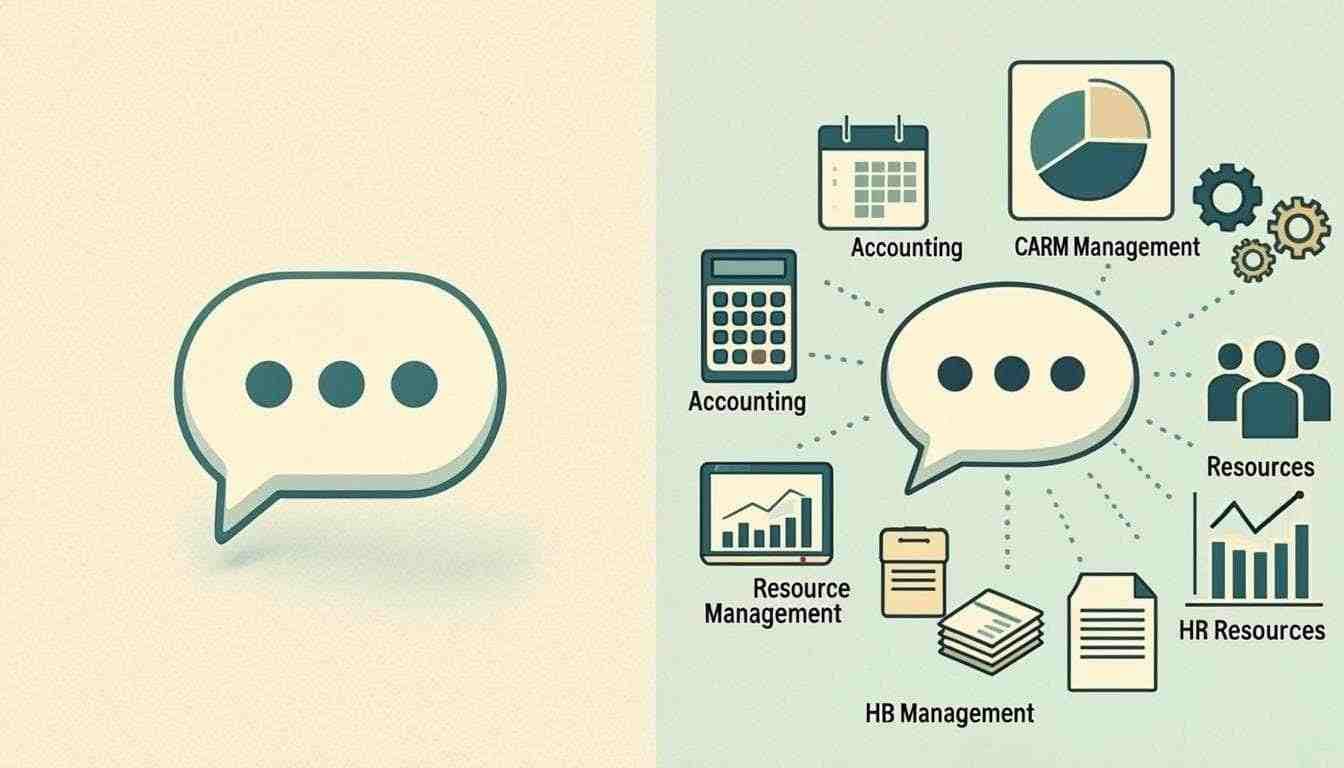
All-in-one business software is the most overused term in the SaaS industry. Every platform claims to be all-in-one; very few actually are. The confusion exists because the term is used to describe two very different things: (1) a unified platform where multiple business functions share a single data model, and (2) a suite of separate tools sold under one brand with integrations between them. The first is genuinely all-in-one. The second is a marketing label.
This guide provides a complete definition of all-in-one business software, explains the difference between true unified platforms and false suites, and helps you identify which category any given product actually belongs to.
What All-in-One Business Software Actually Is
A true all-in-one business platform has three defining characteristics:
- Multiple business functions in one subscription: CRM, projects, finance, HR, and communication are all included as native modules
- Natively connected data: a deal closed in CRM automatically creates a project, drafts an invoice, and posts to the GL without manual handoffs
- One login, one interface, one data model: all modules share the same database, the same UI patterns, and the same permission system
The test of all-in-one: when a deal closes, does the system automatically create a project, assign tasks, draft an invoice, and notify the team without any human handoff? If yes, it is a unified platform. If no, it is a suite of tools sold under one brand.
True All-in-One vs. False All-in-One
| Characteristic | True All-in-One (Unified) | False All-in-One (Suite) |
|---|---|---|
| Data model | One shared database | Separate databases per app |
| Module connection | Native, structural | Via integration/API |
| Login | One login for all modules | Same SSO, different interfaces |
| Deal-to-invoice flow | Automatic, native | Requires integration setup |
| Data consistency | Instant (same database) | Delayed (sync latency) |
| Examples | Recentriq | ClickUp + integrations, Monday + CRM add-on |
- CRM, PM, accounting, HR, chat — all native
- Deal close to project created to invoice drafted — auto
- One login, one interface, one database
- PM tool + CRM add-on + accounting integration
- Deal close to manual handoff to PM to manual invoice
- Same SSO but different interfaces per module
Why All-in-One Matters for SMBs
False all-in-one platforms (suites) require ongoing integration maintenance: Zapier flows, API syncs, manual reconciliation. This maintenance tax — 5–10 hours/month — does not exist with a true all-in-one platform, because the modules share one database natively.
Frequently Asked Questions
All-in-one business software is a single platform where CRM, projects, finance, HR, and communication share one data model. The defining test: when a deal closes in CRM, does the system automatically create a project, draft an invoice, and notify the team without manual handoffs? If yes, it is a true unified platform (like Recentriq). If no, it is a suite marketed as all-in-one.
An all-in-one platform has one shared database across all modules. A software suite offers multiple apps under one subscription, but each app has its own database and connects via integrations. The suite provides breadth but not native connection; the all-in-one provides both.
Partially. Zoho One includes 45+ apps under one subscription. However, each Zoho app is a separate product with its own database. Data flows between them via built-in integrations. Zoho One is the closest thing to all-in-one from a coverage standpoint, but architecturally it is a suite of connected apps, not a single unified platform.
True all-in-one platforms for SMBs range from $5/user/month (Recentriq, all modules included) to $45/user/month (Zoho One, 45+ apps). For a 10-person team, Recentriq costs $50/month vs. Zoho One at $450/month — a $4,800/year difference.
The Best CRM for Small Business in 2026
If you've ever found yourself asking, "what is crm in business" or "how does a crm work", you're not alone. Many founders struggle to define exactly what does CRM mean in business because traditional platforms make it overly complicated. At its core, CRM (Customer Relationship Management) is simply how you track, engage, and monetize your audience. But how CRM works shouldn't require a dedicated consultant.
Moving Beyond Basic CRM Business Processes
When defining a crm project description, the first step in the crm process is centralizing your data. Unfortunately, many teams outgrow simple tools and are forced into bloated enterprise software. Whether you are wondering what a CRM process is or researching crm business requirements and crm requirements gathering, the truth is that the best CRM software for small business is one that connects directly to your operations.
The Ultimate Hubspot Alternative
If you are tired of paying enterprise prices, Recentriq serves as the ultimate Hubspot alternative. Instead of just managing contacts, Recentriq links your CRM directly to project execution and invoicing. This makes it unequivocally the best CRM for small business 2026. Stop worrying about exactly what crm stands for in business (or the meaning of crm in business), and start using a platform that actually drives revenue.
Stop juggling five tools.
Run your whole business on one.
Recentriq brings CRM, projects, documents, accounting, and trading operations into a single context-linked workspace — so every team, every deal, and every dollar lives in one place. No more tab-switching. No more silos. No more guessing what your numbers actually mean.